The Problem
Nigerian gyms were running on paper. Member records lived in notebooks, payments were cash-only, and attendance was not tracked at all. No affordable system existed that worked on shared hosting, handled local payment rails, and could be set up by a non-technical gym owner without documentation or a setup call.
Overview
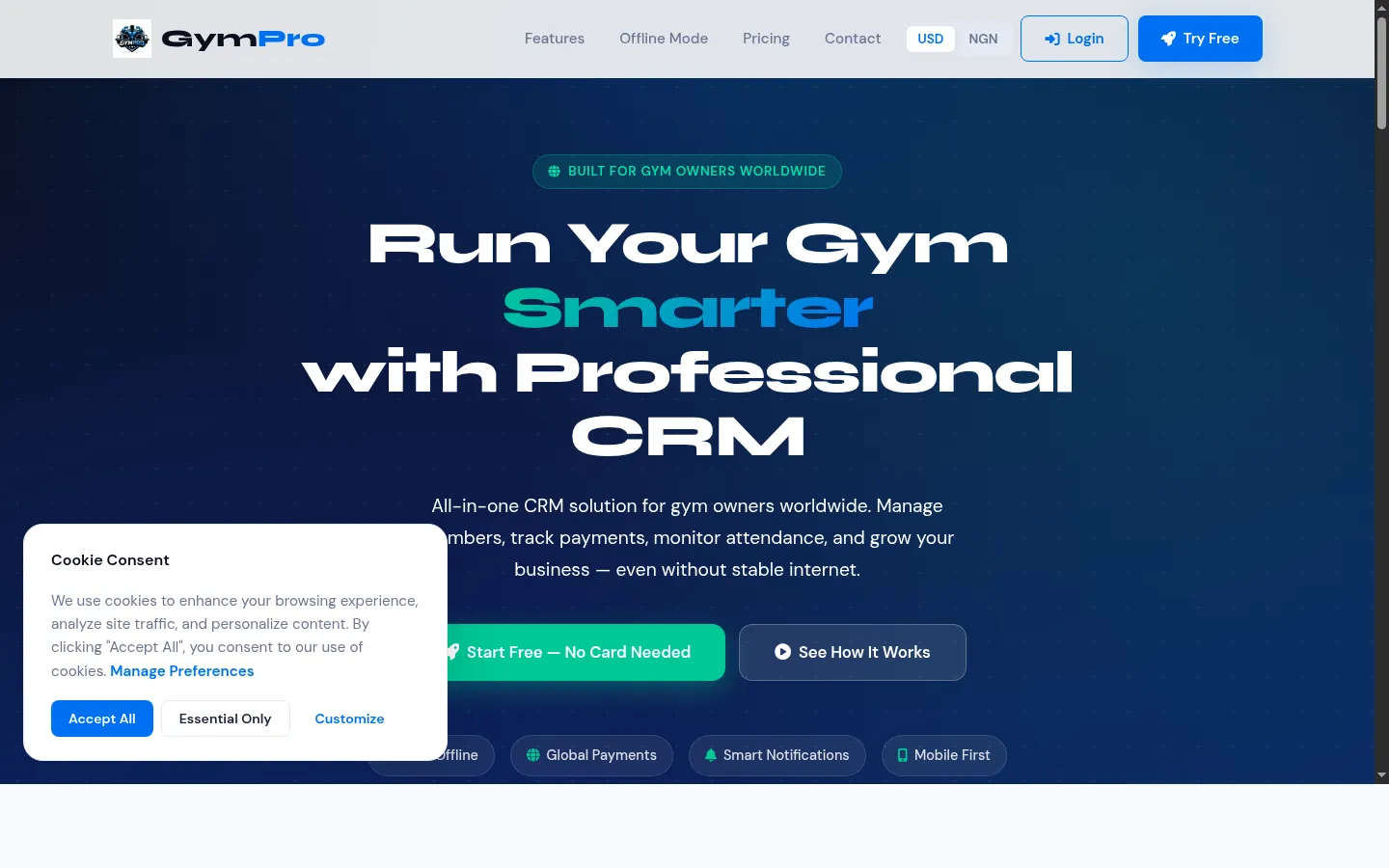
GymProHub is a gym management SaaS platform built specifically for Nigerian gyms. A gym owner signs up and gets a complete operations platform: member management, attendance tracking, membership plans, payment collection, staff management, class scheduling, analytics, and a self-service member portal. The platform is multi-tenant and every record is scoped by gym_id.
Four subscription tiers serve gyms from solo operators to enterprise chains. Free gives 20 members and 1 staff account with the platform watermark visible and ads shown. Core adds 100 members, 3 staff, role-based access control, audit logs, and SMS quota. Portal adds 300 members, 5 staff, a self-service member portal at a slug-based subdomain, class scheduling, inventory tracking, and white-label branding. Enterprise is unlimited members and staff, plus REST API access with webhooks, custom domain support, SSO, and a dedicated account manager.
Every gym gets its own Paystack subaccount. Members pay into the gym's subaccount and settlement goes directly to the gym's bank account. The platform takes a commission at the transaction level.
My Role
- Defined the product strategy and architecture: multi-tenant model, subscription tier structure, feature gating logic, and the overall gym management workflow
- Specified what sits at each pricing tier and why: Free is genuinely usable to prove value, Core adds the operational features gyms need at scale, Portal adds the member-facing experience, Enterprise adds automation and integration
- Designed the per-gym Paystack subaccount model: gyms receive payments directly into their own bank accounts rather than waiting for a manual payout from the platform
- Designed the QR check-in flow for walk-in day-pass payments: no staff involvement, no account required from the visitor
- Defined the white-label branding system for Portal and above: custom logo, colours, CSS injection, and hidden GymProHub branding
- Specified the staff permission model: gym owner, trainer, and receptionist each have different access scopes, configurable at the RBAC level
- Designed the PWA offline strategy: operations queue locally and sync to the server on reconnect, so check-in works even when connectivity drops
Stakeholders
- Gym owners (primary buyers)
- Gym members (end users)
- Gym staff (daily operators)
- Paystack (payment partner)
- SMS gateway providers (Termii, Africa's Talking)
Technical Context
Single codebase, single database, every table scoped by gym_id. The stack is PHP 8+ with PDO and MySQL 8, no framework, Apache with .htaccess routing. This keeps the stack lean and deployable on standard shared hosting without a build pipeline, which is important for the target market.
Paystack integration uses a per-gym subaccount model. When a gym owner sets up payment settings, the platform calls the Paystack API to create a subaccount linked to their bank account. From that point, all member payments go into the subaccount with a commission split at the transaction level.
SMS uses Termii as the primary gateway with Africa's Talking, SMSLive247, and BulkSMS Nigeria as alternatives. The member portal (Portal+ tier) is accessible at a slug-based subdomain. The PWA service worker caches member and plan data locally. Enterprise API endpoints authenticate via SHA256-hashed API keys with rate limiting and full audit logging.
Key Decisions
Challenges
Discovery
The opportunity was visible without formal research. Nigeria has a growing gym culture, particularly in Lagos and Abuja, and the management infrastructure had not kept up with it. Gym owners were running on paper: attendance in notebooks, membership payments in cash, member records nowhere. No affordable system existed that worked on shared hosting, handled local payment rails, and could be set up by a non-technical gym owner without support.
Stakeholder Friction
The one area of genuine friction was around the free tier limits. The initial thinking was to make the free tier quite restricted to push earlier conversion. The counter-argument was that a free tier designed to frustrate produces churn rather than upgrades. The current free tier, supporting 20 members and full core functionality, reflects the second position.
Outcomes
Technology Decisions
What I'd Change
I would have moved the member portal feature to the Core tier rather than the Portal tier. Gym owners on Core regularly ask for a way to let their members check their own attendance records and plan status. The Portal tier threshold was commercially reasonable, but in practice it locked a feature behind a paywall that would have reduced daily staff workload for the majority of gyms on Core.