JobHunt
AI-powered job application platform aggregating 8 job sources with Gmail OAuth sending
The Problem
Job searching is genuinely fragmented. Applications live in spreadsheets, job boards are siloed, cover letters get written from scratch for every role, and sending applications means juggling tabs. The overhead is highest during periods of unemployment, exactly when people have the least time and money to spare.
Overview
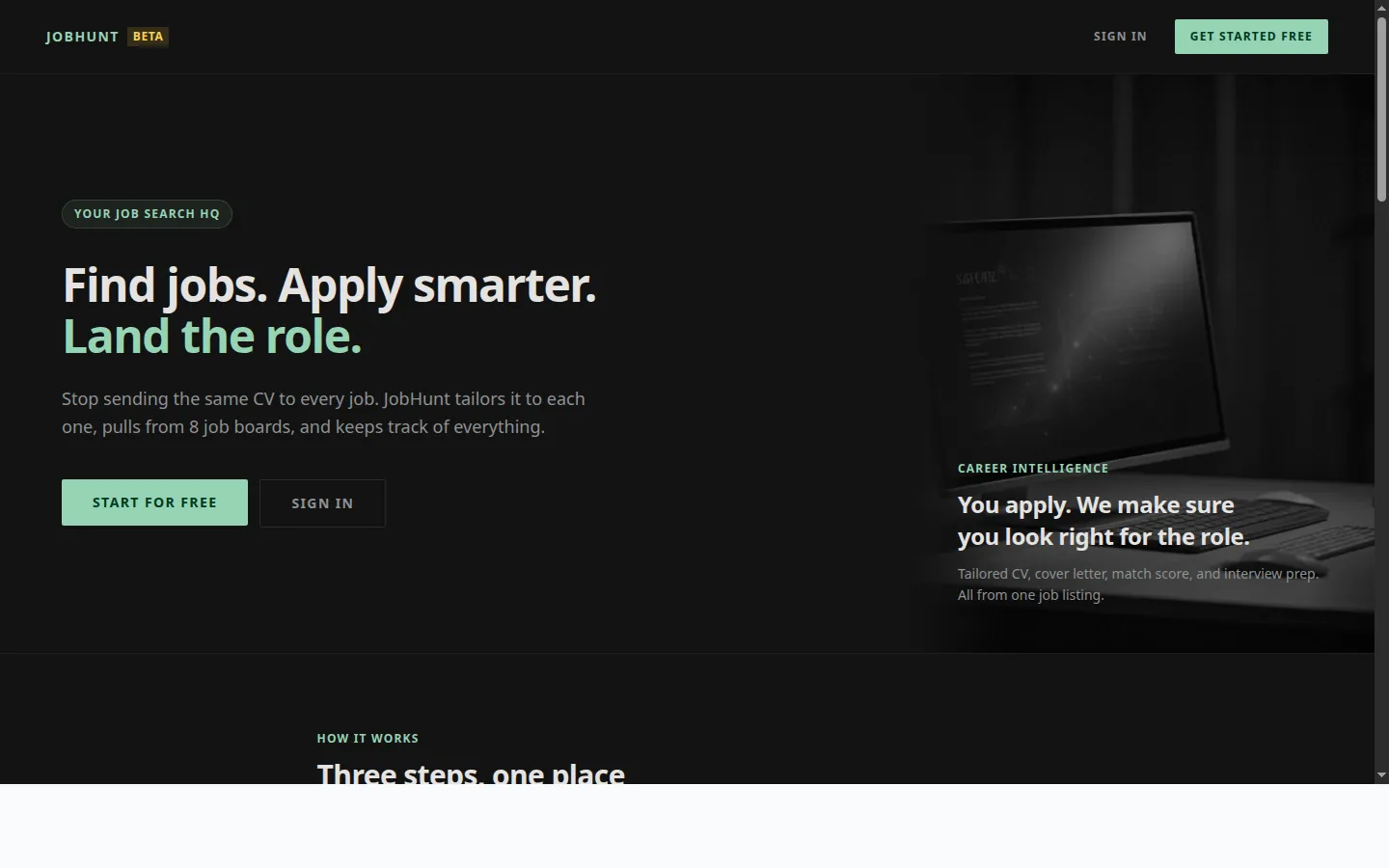
JobHunt is a job application platform designed to consolidate the entire job search workflow into one place. It pulls listings from 8 job boards simultaneously, deduplicates them, and lets you filter by job type, recency, and keywords. Applications are managed through 6 stages: Draft, Applied, Interview, Offer, Rejected, Withdrawn.
The AI layer is powered by Gemini 2.5 Flash Lite. From a job listing, you can tailor your CV to the role, generate a cover letter in three styles (formal, casual, or creative), and generate 10 interview questions across technical, behavioural, company, and situational categories. You can also analyse your CV, analyse your LinkedIn profile, and rebuild CV text that came out garbled from a badly structured PDF.
Every piece of AI output is editable before it goes anywhere. When you are ready to apply, you connect your Gmail via OAuth2 and send the email directly from your own address.
My Role
- Conceived the product and defined the full feature set: multi-source job aggregation, 6-stage application tracking, AI writing assistance, and Gmail OAuth sending
- Designed the AI feature set: 6 distinct features with tailored prompts, editable outputs, and per-user rate limiting per feature
- Made the core product decision that all AI outputs are editable before going anywhere
- Specified the job source normalisation approach: one internal Job schema that every source maps to
- Defined the Gmail OAuth flow: connect once, applications send from the user's own address
- Designed the 4-step onboarding flow: profile, job preferences, LinkedIn capture, CV upload
- As a solo-stage project with no separate engineering team, I contributed directly to development alongside product ownership.
Stakeholders
- Job seekers (primary users)
- Hiring managers (indirect, as email recipients)
- Google (Gmail OAuth partner)
- Job board APIs (Remotive, Adzuna, Jobicy, Himalayas, and others)
Technical Context
Next.js App Router with React 19 and TypeScript. Supabase handles the PostgreSQL database with Row Level Security enforcing user data isolation at the database level.
The job aggregation runs via API route on demand and via Vercel cron in the background. Each source is fetched in parallel and results are upserted by a unique constraint on (user_id, source, external_id). The AI features use Gemini 2.5 Flash Lite with rate limiting via Vercel KV.
Gmail OAuth stores the access token and refresh token in the database. Before sending an email, the route checks token expiry and refreshes automatically if needed.
Key Decisions
Challenges
Discovery
The brief came from a client who builds tools for people around him. The job search problem was one he had watched friends struggle with: applications spread across spreadsheets, cover letters rewritten from scratch for every role, and no clean way to track where everything stood.
Stakeholder Friction
The main scope cut was a direct employer posting feature that would have let companies list jobs on the platform. Doing both the job seeker side and the employer side in the same release was not realistic, and a half-finished employer experience would have undermined the job seeker product.
Outcomes
Technology Decisions
What I'd Change
Weekly job digest emails. The usage pattern across beta users is intense in the first week, then quiet. A weekly email surfacing five matched roles based on each user's saved preferences would create that loop without requiring any action from the user.