NaijaBased
Nigerian business discovery and ordering platform, 2,200+ businesses, zero paid acquisition
The Problem
Nigerian businesses had no affordable, practical way to get found online without advertising. Existing directories either required paid listings upfront or lacked the local context that would make them useful: QR menus, Paystack ordering, neighbourhood-based search. There was a clear gap between what platforms offered and how businesses in Nigeria actually operated.
Overview
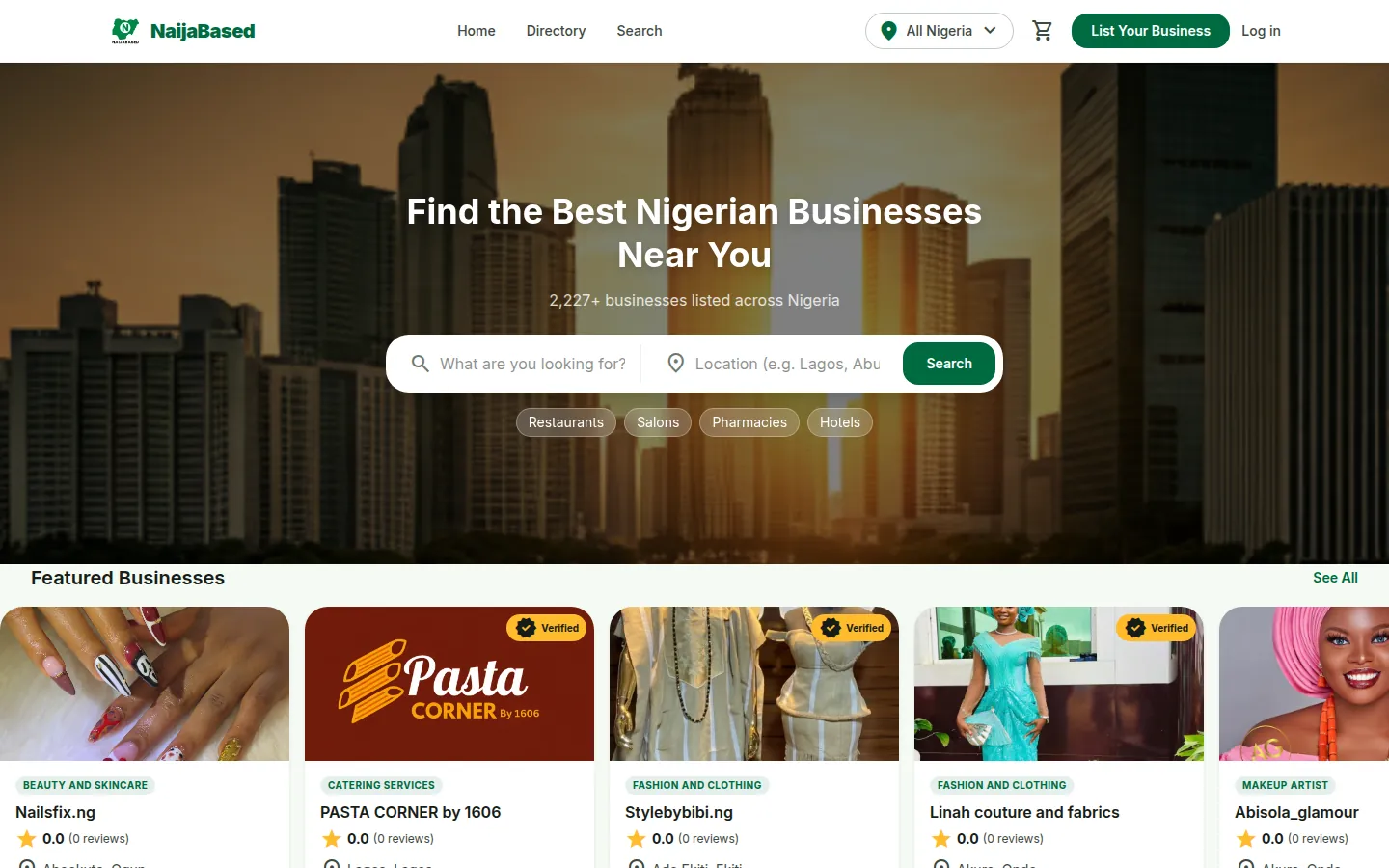
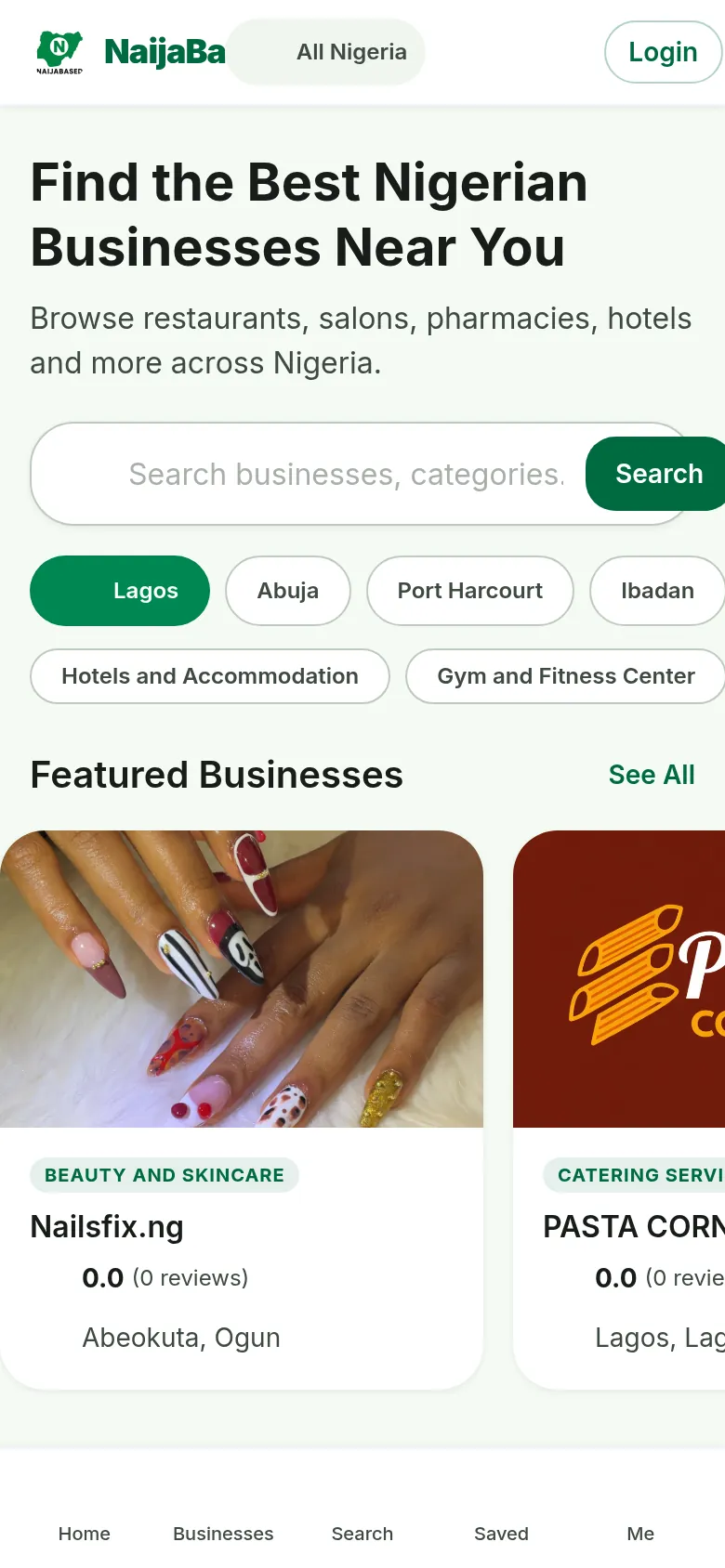
NaijaBased is a business discovery and ordering platform for the Nigerian market. Customers use it to find local businesses, browse digital menus via QR code, and place orders with Paystack checkout. Business owners list their businesses, manage menus, handle orders, and withdraw earnings. It covers all Nigerian states across 182 business categories and grew to 2,200+ listed businesses entirely through organic SEO, with no paid acquisition.
The platform has two sides: a consumer-facing discovery and ordering experience, and a vendor portal where business owners manage their operations. Both went through two major phases.
V1 was a PHP monolith that had grown into a full social and commerce platform. The feature set covered: business listings with category, city, and state SEO pages; a jobs board; events with Paystack ticketing and QR code download; a marketplace with buyer-seller messaging; community groups (each with their own gallery, store, and events); professional portfolio pages; a social feed with posts, hashtags, and sponsored content; a discover feed; direct inbox messaging; a wallet with transaction history and withdrawals; a referral and points system with a leaderboard; KYC verification; a platform ads system; saved items; notifications; profile view tracking; and an analytics module. The vendor side had three separate dashboard codebases by business type: restaurant, retail, and service. A bonus programme rewarded vendors for hitting monthly revenue milestones, with Bronze, Silver, and Gold tiers paying out up to 10,000 NGN. A separate HQ admin panel at hq.naijabased.fun handled platform-level moderation and operations.
V2 was a deliberate cut. With over fifteen modules running on one codebase, any change to shared infrastructure had to be tested across all of them. Feature velocity on the core product had slowed to a crawl. The decision was to strip the platform back to what was actually driving value: business discovery and ordering. Jobs, events, communities, marketplace, social feed, inbox, points, KYC, ads, and the bonus programme were all removed. The vendor portal moved to Next.js with a single unified dashboard replacing the three separate V1 codebases, covering order management, menus, customer tracking, analytics, wallet, and withdrawals for all business types.
A third surface was added alongside V2: shop.naijabased.fun, a standalone e-commerce platform for businesses that want a dedicated storefront. It shares authentication with the main platform via SSO, using a JWT token scoped to the .naijabased.fun domain so users move between the two without logging in again.
My Role
- Designed the organic SEO growth strategy: every business profile is its own crawlable page with clean URLs, location-specific metadata, and Schema.org LocalBusiness structured data
- Designed the freemium onboarding for business owners: minimum required fields, mobile-optimised form, no payment details required upfront to get listed
- Designed the full monetisation model: free listing for discovery, featured monthly and annual placement, Menu Pro subscription for QR menus and ad-free ordering pages, and a platform ads system
- Defined the V1 product scope across 18 surfaces: business listings, jobs, events with Paystack ticketing and QR tickets, marketplace with buyer-seller messaging, community groups (each with posts, gallery, store, and events), professional portfolio pages with testimonial workflows and contact tracking, social feed with hashtags and sponsored posts, direct inbox messaging, wallet, referral and points with leaderboard, KYC, ads, notifications, and analytics
- Designed the vendor bonus programme in V1: Bronze, Silver, and Gold tiers rewarding vendors for monthly revenue milestones with NGN payouts
- Specified and oversaw the HQ admin panel (hq.naijabased.fun): a separate operations platform covering business moderation, user and KYC management, marketplace moderation, withdrawal approvals, event management, a platform blog, and a moderators management system
- Led the V2 scope decision: cut fifteen peripheral modules, retain business discovery and ordering, rebuild the consumer frontend in Next.js while keeping PHP as the backend API
- Designed the V2 vendor portal as a single unified dashboard for all business types, replacing three separate V1 codebases
- Specified the shop subdomain (shop.naijabased.fun) as a standalone storefront platform with SSO from the main platform, covering store, service, and food business types each with their own analytics, bookings, payments, and withdrawals
- Defined the QR menu product: businesses generate a QR code linking to their branded digital menu with direct Paystack ordering
Stakeholders
- Business owners (vendors)
- Consumer users
- Professional portfolio users
- Community group members
- Platform moderators (HQ)
- Backend PHP developer
- Next.js frontend team
- Paystack (payment partner)
Technical Context
V1 was a PHP monolith with session-based auth and MySQL on Namecheap shared hosting. Every module lived in the same codebase: shared config, shared includes, shared session handling. Paystack handled all payments, Brevo SMTP handled transactional email, Mocean handled SMS. Sitemap files were generated per content type (businesses, categories, cities, states, professionals, jobs, events, marketplace) and submitted for SEO indexing. Social login was handled via OAuth callbacks. The community module ran its own gallery, store, and event system per group. Professional portfolios tracked contact clicks and WhatsApp button taps for each listing.
The HQ admin panel (hq.naijabased.fun) was a completely separate PHP application. It gave platform staff visibility and control over every module: business approvals, claims, verification, user management, KYC review, marketplace moderation, withdrawal processing, event management, a blog editor, and a moderators system. It was not connected to the consumer codebase, it accessed the same database directly.
The shop platform (shop.naijabased.fun) was also a separate PHP application with three distinct vendor dashboards: store (retail products), service (appointments and schedule), and food/business (menu items and orders). Each dashboard type had analytics, payment settings, booking management, transactions, and withdrawals. Vendor settlement used Paystack subaccounts.
Consumer site V2 is Next.js 16 with React 19, TypeScript, and Tailwind CSS v4. The PHP codebase was retained as a REST API at api.naijabased.fun/api/v1. The Next.js app proxies all data calls to the PHP API. Auth uses a JWT token in an httpOnly cookie. ISR handles caching with 60-second revalidation on API calls and 300-second revalidation on business profile pages. Business profiles use Schema.org LocalBusiness structured data.
Key Decisions
Challenges
Discovery
The platform did not start as NaijaBased. The client lived in Akure and was frustrated by the same problem every day: he could not find reliable information about local businesses online, their menus, their opening hours, who to contact. He built AkureBased, a simple directory for his city. Then businesses from Ibadan started asking for the same thing, so he built IbadanBased. Demand from other states followed without any outreach. The expansion to a national platform under the NaijaBased name was a response to real, unsolicited demand, not a top-down product decision.
Stakeholder Friction
There was no disagreement about paid acquisition versus organic. There was not enough budget for ads, and the client was not willing to seek external financing. The real friction was operational: getting businesses to complete their listings at all. Most early outreach happened through social media accounts with little to no following, which meant every onboarding was a manual effort.
Outcomes
Technology Decisions
What I'd Change
Invest in marketing earlier. The organic SEO strategy worked, but the 26x click growth in 5 months shows what was possible once the right foundation was in place. Growing to 2,200 businesses on zero budget proved the product's value. Scaling that with actual marketing investment was always the next step, and deferring it indefinitely slowed the platform's reach more than any product limitation did.